Guidance / Hallmarking
Hallmarking, and why it is the first thing on every page.
Last updated 12 August 2026 · Governing law: England and Wales
What a hallmark is
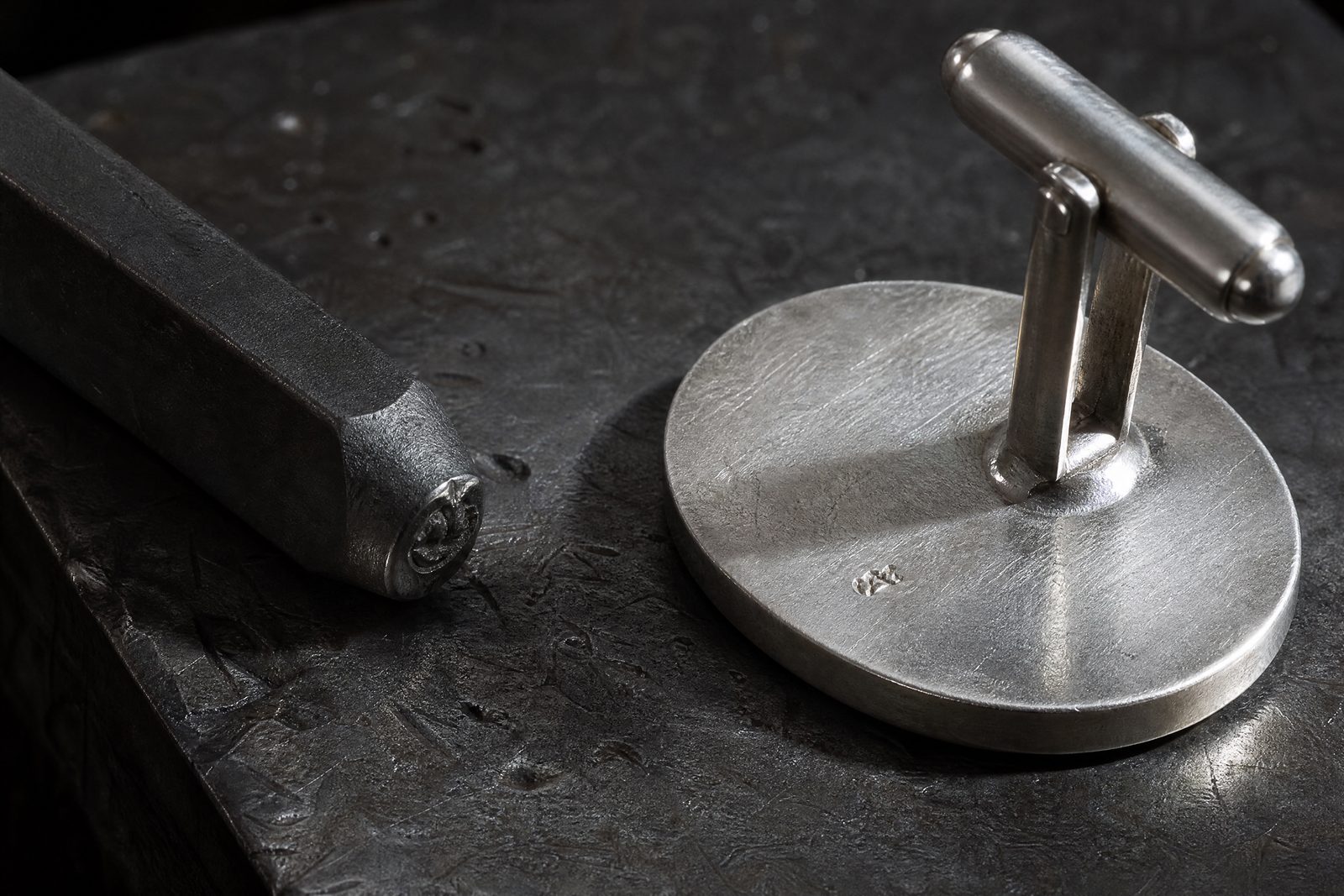
A hallmark is a set of small marks struck into a precious metal article by an independent assay office after the metal has been tested. It is not a maker’s decoration and not a quality badge a seller can award itself. It is an independent statement that the metal is what the seller says it is.
There are four assay offices in the United Kingdom: London, Birmingham, Sheffield and Edinburgh. Our articles are struck at the Sheffield Assay Office, which has marked silver in this city since 1773.
Reading the marks
A UK hallmark has three compulsory parts and one optional one. On a small article they are struck in a line and are often only legible under a loupe.
- Sponsor's mark. The registered mark of the person or company that submitted the article for assay. Two or more letters inside a shaped surround.
- Fineness mark. The metal and its purity in parts per thousand: 925 for sterling silver, 375 for 9ct gold, 750 for 18ct, 950 for platinum.
- Assay office mark. Which office tested and struck the article. A rose for Sheffield, a leopard's head for London, an anchor for Birmingham, a castle for Edinburgh.
- Date letter. Optional since 1998. A letter in a shaped surround giving the year the article was marked.
Statutory exemption weights
Below a certain weight an article may be lawfully described as precious metal without being hallmarked. The threshold differs by metal, and it applies per article.
| Metal | Exemption | Relative |
|---|---|---|
| Silver | 7.78 g | |
| Gold | 1 g | |
| Platinum | 0.5 g | |
| Palladium | 1 g |
Weights are per article, not per pair or per set. A pair of cufflinks is two articles: each link is weighed and marked on its own.
Where one of our articles falls under its exemption weight we say so on the product page and give the figure, rather than leaving the absence of a mark unexplained. Of the 41 articles in the catalogue, 18 are struck, 14 are precious metal below the exemption, and 9 are base metal to which hallmarking does not apply.
How we enforce it
The rule is written into the code that builds this site, not into a procedure someone has to remember. Any precious metal article recorded above its exemption weight without a struck mark is withheld from the storefront automatically and flagged in the back office with the reason. A data-entry mistake therefore removes an article from sale rather than publishing an unlawful description of it.
Cufflinks are weighed one link at a time
This is the point most often got wrong in our category. A pair of cufflinks is two articles, not one. The exemption weight is tested against a single link, and where it applies, each link is struck individually — a hallmarked pair carries two marks, and a set of four dress studs carries four.
We publish both figures on every pair: the net weight per link, which is the number the law uses, and the combined weight of the pair, which is the number you can feel. A pair at 5.4 g a link weighs 10.8 g together but is judged at 5.4 g.
Base metal articles
Stainless steel, brass and titanium are not precious metals. Hallmarking does not apply to them, no mark exists for them, and we claim none. Our product data structurally prevents a base metal article from rendering any hallmarking language at all: the fields do not exist on those records and the page has no way to print them.
Where an article is base metal, the words base metal appear in its metal description, on the card in the catalogue and in the specification block on its page.
Plating, fineness and honest description
Under the Consumer Protection from Unfair Trading Regulations 2008 a description must not mislead. In this category that means two things in particular.
- Fineness is not rounded up. 925 is sterling silver; 375 is 9ct gold; 585 is 14ct; 750 is 18ct; 950 is platinum. We do not describe an article as a fineness it has not been assayed at.
- Plating is named as plating. Rhodium-plated, gold-plated, gold-filled, vermeil and gold-tone are five different things and we use the term that is accurate. Vermeil requires a gold layer of at least 2.5 micron over sterling silver; where we describe something as vermeil, that minimum is stated. Nothing plated is ever described as solid.
- A plated article is marked for its body metal. Our rhodium-plated cufflinks are sterling silver underneath and hallmarked as sterling silver. Rhodium is a platinum-group metal, but the article is not platinum and is not offered as platinum.
Dealer’s Notice
Dealers in precious metals are required to display the statutory notice explaining the approved hallmarks. It is reproduced here in full.
Statutory notice — UK hallmarks
It is an offence for any person in the course of a trade or business to describe an unhallmarked article as being wholly or partly made of gold, silver, platinum or palladium, or to supply such an article to which such a description is applied.
The following articles are exempt from hallmarking by reason of weight: gold articles weighing less than 1 gram, silver articles weighing less than 7.78 grams, platinum articles weighing less than 0.5 gram, and palladium articles weighing less than 1 gram.
A UK hallmark comprises the sponsor’s mark, the fineness (purity) mark and the assay office mark. The date letter is optional. Approved hallmarks also include those struck by assay offices in other states that are recognised in the United Kingdom, and the Convention Hallmark.
If you would like a copy of this notice with the illustrated marks, or you would like us to confirm the marks on a particular article before you order, write to support@pajewelleryuk.shop or call +44 7528 455575 and we will send it.
If you want the mark checked
Any UK assay office will examine an article and confirm its marks. If you buy from us and want the hallmark verified independently, tell us and we will tell you which office struck it and when.